
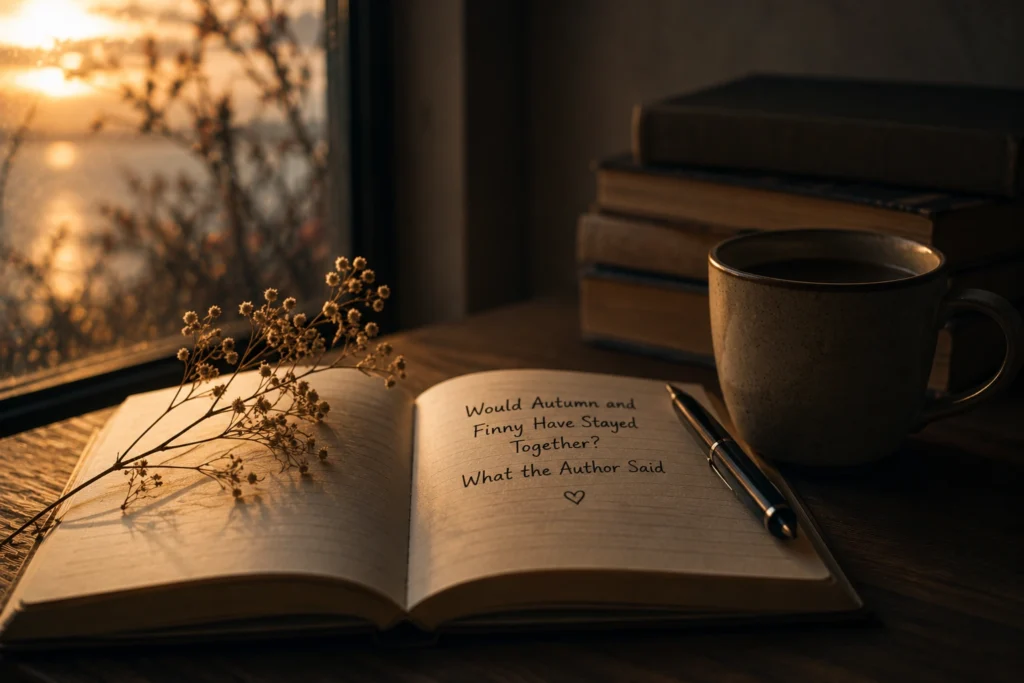
Of all the questions readers carry after finishing If He Had Been With Me, this one might be the most persistent. It is not just grief for what happened. It is the deeper, more complicated grief of wondering whether it would even have worked. Whether Finny had lived, whether he had come back that morning the way he promised, whether they had found each other before it was too late: would Autumn and Finny have built something lasting? Or would they have burned bright and brief and ended anyway?
Laura Nowlin answered this question directly on Goodreads, and her answer is one of the most honest and uncomfortable things she has ever said about her characters.
What Laura Nowlin Said
When a reader asked Nowlin directly on Goodreads whether Autumn and Finny would have stayed together if Finny had not died, her answer was careful and genuinely ambiguous:
She said she honestly did not know. That statistically, it was unlikely they would have lived happily ever after. But that everyone knows at least one genuinely happy couple that got together in high school. So the honest answer was that she could not say.
That response has frustrated and moved readers in equal measure. It is not the answer most people want. Most people want confirmation that the love was real and the future would have matched it. But Nowlin’s refusal to give that confirmation is itself an answer of sorts: she built characters complex enough that their future genuinely cannot be guaranteed, even by the person who created them.
Why the Question Is More Complicated Than It Looks
On the surface, this seems simple. Autumn and Finny loved each other. They finally said so. They spent one night together. If Finny had lived, they would have been together. The end.
But the novel plants complications throughout that make this harder to accept at face value.
The first is Autumn’s own novel. The fictional story she has been writing throughout the book depicts a version of herself and Finny who never drifted apart. When Finny reads it, he reads it as the love confession it is. But earlier, Autumn reflects on the ending of her fictional story and notes that even in her imagined version of their lives, she is not sure they would have stayed together forever. That detail is quiet but significant. Even in the fantasy she constructed for herself, she built in uncertainty.
The second complication is who they are as people. Autumn is chaotic, creative, avoidant, and prone to self-deception. Finny is patient and emotionally restrained, but he is also capable of spending four years not saying something that needed to be said. Their dynamic, built on unspoken things and accumulated miscommunication, is not automatically resolved by one honest night. The habits of years do not disappear with a single confession.
The third complication is external pressure. Both of them were heading into completely different phases of life. College, distance, new environments, new people. High school relationships, even the most genuine ones, survive that transition at significantly lower rates than relationships built in more stable circumstances.
The Case for Yes: They Would Have Made It
None of the above means the answer is no. There is an equally strong case for optimism.
Finny’s love for Autumn was not a high school crush. The sequel makes clear it was a childhood love that formed before either of them was old enough to name it. That kind of love, rooted in genuine knowledge of the whole person rather than proximity and novelty, is the kind that does survive. It survived four years of deliberate distance and a relationship with someone else. It was not a feeling that faded when she was not in front of him.
Autumn’s love was similarly deep. Even when she refused to acknowledge it, it shaped every significant choice she made in high school. She stayed with Jamie partly because she could not bear to risk Finny’s vulnerability. That level of feeling does not dissolve easily.
There is also the question of what they built in the summer before it ended. They did not confess feelings out of nowhere. They rebuilt a friendship first, slowly and genuinely. They became people who chose each other again before they became people who loved each other romantically. That foundation is more solid than most high school relationships have.
The Case for Uncertainty: What Nowlin Is Really Saying
Nowlin’s ambiguity is not cruelty. It is honesty about what love actually is.
The novel is fundamentally about the cost of leaving things unsaid. Its central argument is that you should tell the people you love how you feel, while you still have time. The title is the evidence. If he had been with her, everything would have been different.
But Nowlin is too honest a writer to pretend that saying the true thing is a guarantee of anything. People who love each other still break up. Relationships that begin in mutual honesty still end. The point was not that confessing would have given them forever. The point was that confessing would have given them time, and time was the thing they were denied.
Asking whether they would have stayed together forever slightly misses what the novel is actually mourning. It is not mourning a happy ending that never happened. It is mourning a beginning that came too late.
What If Finny Had Lived: A Realistic Picture
If Finny had driven back that morning, had broken up with Sylvie, had come back to Autumn the way he promised: here is what the most honest picture of their future probably looks like.
They would have had a real relationship, probably for the rest of that summer and into college. It would have been complicated. Autumn’s avoidance and Finny’s patience would have created friction differently than they did in the friend zone, more intimately and with less distance to hide behind. They would have had to learn to communicate in ways neither of them had ever managed.
They might have broken up at some point. They might not have. The novel does not give us enough information to say with confidence. What it does give us is the certainty that they would have had the chance to find out, and the tragedy is that the chance was what was taken.
What the Sequel Adds to This Question
If Only I Had Told Her does not directly answer the question either. But Finny’s chapters, which show his inner life across the years of distance and restraint, give us something useful: the depth and consistency of his feeling.
Finny is not a person who loved Autumn because she was available, convenient, or the girl next door. He loved her specifically, in detail, for reasons that accumulate across years. That specificity is a strong argument for durability. People who love you because of who you actually are tend to go on loving you as you change in ways that people who love an idea of you cannot.
For a deeper look at Finny’s feelings across the whole novel, see our full analysis of every sign Finny loved Autumn. For the full picture of their relationship from beginning to end, see our friends-to-lovers relationship timeline.
Frequently Asked Questions
Would Autumn and Finny have stayed together if Finny had lived?
Laura Nowlin said she honestly does not know. Statistically, she noted, high school relationships often do not last forever, but she also acknowledged that some do. Her refusal to give a definitive answer is itself meaningful: she created characters complex enough that their future cannot be guaranteed even by her.
Did Finny and Autumn love each other enough to last?
The novel makes a strong argument that their love was genuine, specific, and deeply rooted. But love being real does not guarantee a lasting relationship. The complications of their individual personalities, their communication habits, and the external pressures of college and distance would all have tested something that had only just begun.
What would have happened if Finny had not died?
The most honest answer is that they would have had a relationship, probably a genuine and complicated one. Whether it would have lasted forever is unknown. What they would have had was the chance to find out, and the chance is what the novel mourns.
Does the sequel say whether Autumn and Finny would have stayed together?
Not directly. The sequel shows Finny’s perspective across the years and confirms the depth and specificity of his feelings, which is the strongest argument the duology offers for the possibility of lasting love. But Nowlin does not resolve the hypothetical.
Why did Laura Nowlin not give a clear answer about their future?
Because she is a genuinely honest writer about what love is and what it does not guarantee. The novel’s argument is to say the true thing while you have time, not to promise that honesty leads to forever. Ambiguity about their future is consistent with everything the novel actually believes.