

In If He Had Been With Me, Autumn and Finny grow up inseparable, their mothers’ friendship binding them together. High school pulls them apart through rival social circles, a brutal lunch table war, and new romantic partners. Senior year slowly rebuilds their connection, but intimacy and honesty arrive too late. Finny dies in a sudden accident, leaving Autumn to carry grief, regret, and his child. This is the complete plot summary, character analysis, and story breakdown you need.
Key Takeaways
- Autumn and Finny’s childhood friendship, rooted in their mothers’ bond, forms the emotional foundation driving every major conflict throughout the novel.
- High school separates them socially, with Finny joining the popular crowd while Autumn aligns with misfits, creating tension symbolized by a lunch table war.
- Senior year gym class and shared experiences gradually rebuild their connection, culminating in a mutual confession of feelings.
- Finny dies in a tragic accident just after confessing his love to Autumn, before their relationship can begin.
- Autumn’s grief unfolds through numbness, depression, a suicide attempt, and the discovery of a pregnancy that ties Finny’s legacy to her future.
If He Had Been With Me: Full Plot Summary and Analysis

If He Had Been With Me is a young adult novel by Laura Nowlin, published April 1, 2013, by Sourcebooks Fire. It follows Autumn Davis, a self-described misfit navigating high school, a safe relationship with her boyfriend Jamie, and the slow realization that she has always loved her best friend from childhood, Finny. The plot summary that follows covers the full story from beginning to end, including the ending, the characters, and the themes that make this one of the most emotionally resonant books in contemporary YA fiction.
For a complete character analysis of every person in the novel, see our dedicated guide. This summary focuses on the plot, the journey, and the emotional impact of each major development.
How Autumn and Finny’s Friendship Began
Autumn and Finny’s friendship didn’t start gradually it was there from the very beginning. Their mothers were best friends, and the two families lived next door to each other, which meant Autumn and Finny were constantly together from a young age. That proximity created something rare — a bond so deep they could finish each other’s sentences and instinctively know what the other needed when they were hurting.
Before middle school, they did everything together. They moved through shared family circles and a unified neighborhood world without ever drifting into separate social groups. There was no division, no distance just two kids who genuinely grounded each other.
What makes their early friendship so significant is its emotional depth. Finny gave Autumn a sense of completeness, and together they built a foundation of mutual comfort and understanding. That foundation is what makes the story’s central “what if” so achingly powerful. The novel ultimately reflects on how treasuring relationships shapes the way we experience both joy and loss.
How High School Tears Their Friendship Apart
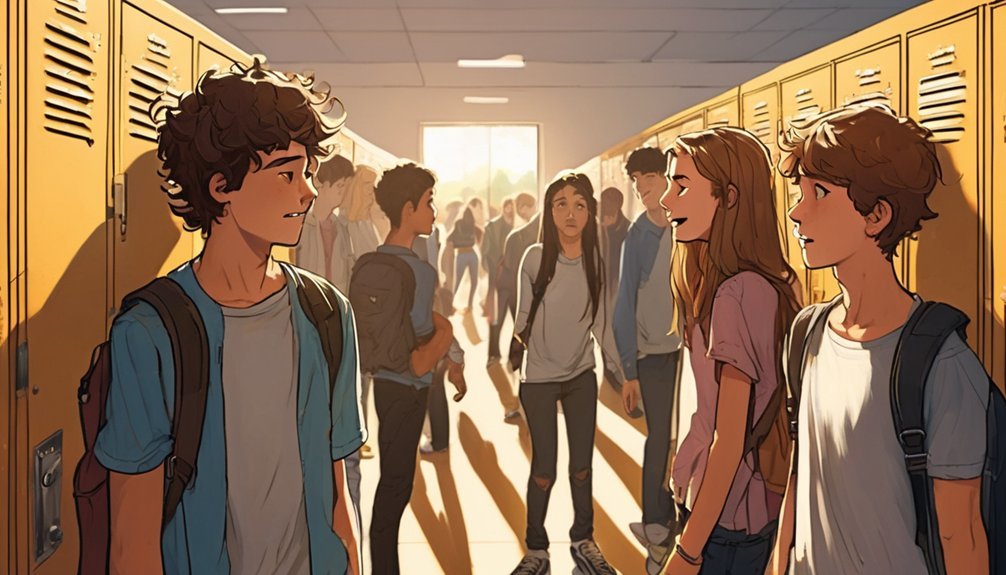
When Autumn and Finny enter high school, their already fragile connection shatters completely as they land in separate classes and drift into opposing social worlds. Finny joins the varsity soccer team, dates a cheerleader named Sylvie, and slides effortlessly into popularity, while Autumn crowns herself queen of the misfits, wears a tiara daily, and builds her identity around her outcast crew.
The tension between their two worlds eventually boils over into an all-out feud over a lunch table, a conflict so intense that their friend groups literally call it The War. Throughout this turbulent period, Autumn begins dating Jamie Allen, a relationship that represents a safe emotional choice rather than a true romantic connection.
Their social worlds make things worse. Finny thrives in the popular crowd while Autumn exists on the margins, and these aren’t just different friend groups, they’re completely separate realities. Their mothers’ close friendship still forces occasional family gatherings, but those moments only sharpen the awkwardness rather than ease it.
Autumn can’t shake the regret. Each time she spots Finny at school, the feelings hit harder — anger, longing, betrayal, loneliness. She tries dismissing them, but they keep building until they’re impossible to ignore. The story explores these friends to lovers dynamics against the backdrop of contemporary high school life, grounding Autumn’s emotional spiral in a setting readers find achingly familiar.
Rival Social Groups and the Lunch Table War
What accelerates the drift into something permanent is the formation of rival social groups. Finny joins the varsity soccer team and falls into the popular crowd, while Autumn lands among the outlier misfits, actively rejected by the cheerleaders. These aren’t just different friend groups — they’re opposing social worlds that never mix.
| Factor | Finny’s World | Autumn’s World |
|---|---|---|
| Social Circle | Popular crowd, varsity soccer | Outlier misfits |
| Romantic Partner | Cheerleader Sylvie | Emo rebel Jamie |
| School Behavior | No acknowledgment of Autumn | Resents Sylvie’s bond with Finny |
| Family Events | Minimal conversation | Visible tension and regret |
| Rivalry Arc | Indirectly protects Autumn | Competition gradually softens |
The lunch table war that erupts sophomore year isn’t about a table; it’s about territory, loyalty, and two social worlds finally declaring themselves enemies. Sylvie’s group steals Autumn’s group’s lunch table, and what follows is weeks of daily battles over who controls that spot. Autumn’s friends dub it “The War.” Finny is caught in the middle; it’s actually his turn to secure the table when Autumn confronts him directly. He backs down, ending the rivalry immediately, but the damage is done. The table war is the moment when their separate social circles stop being an awkward reality and become an open declaration. The story’s emotional weight is further shaped by its exploration of mental health themes woven throughout Autumn’s perspective and inner world.
How Jamie and Sylvie Push Them Further Apart

While Autumn and Finny drift into separate social worlds, their relationships with Jamie and Sylvie cement that distance in ways that feel almost irreversible. Jamie offers Autumn comfort and loyalty, but he’s ultimately a safe choice that keeps her from confronting her real feelings for Finny. Sylvie, meanwhile, anchors Finny to the popular crowd while quietly competing for his full attention.
Autumn resents Jamie’s presence even while staying loyal to him. Finny stays with Sylvie rather than risk reaching toward Autumn. Their respective partners don’t just distract them — they actively fill the emotional space that might have otherwise pulled Autumn and Finny back together. The conflict between what each character wants and what they allow themselves to pursue is the novel’s central dramatic engine.
Senior Year: The Reconnection

Senior year cracks open an unexpected window when Autumn and Finny are paired as gym class partners, forcing proximity after years of drifting in opposite directions. Collaborative exercises rebuild the comfort they’d lost, and shared moments in class remind them both that something real still exists beneath the high school noise.
Together, these shared experiences patch rifts left by freshman-year choices. Their shared family history makes reconciliation easier, and the reduced tension signals genuine willingness on both sides. The gym class partnership is where the novel’s second act truly begins a slow, quiet development that undoes years of social damage without either character fully acknowledging what they’re doing.
The Summer Confession and the Tragic Twist

After graduation, Autumn’s relationship with Jamie collapses when she discovers his feelings for their mutual friend Sasha. That collapse removes the last comfortable barrier between her and the truth of what she feels for Finny. Finny begins showing up constantly, pulling her out of her grief through simple companionship. The childhood friendship reignites through daily interactions and a comfort neither of them needs to explain.
Then Autumn finishes her novel — a creative work that has been shaped entirely by her feelings for Finny without her fully realizing it. She shares it with him. He reads what’s inside it and reciprocates without hesitation. The confession arrives not through a single dramatic scene but through an act of creative honesty that only these two people could have arrived at.
Finny plans to end things with Sylvie. The future, briefly, feels possible.
Then the accident happens. For the full account of how and why Finny dies, see our dedicated article on how Finny dies in If He Had Been With Me. The short version: he is electrocuted by a downed power line in a puddle while rushing to help Sylvie after a drunk driver causes a crash. He dies on the same night he chose Autumn. The timing is the novel’s cruelest structural choice and its most devastating climax.
The Night Finny Dies and Autumn’s World Collapses

The night Finny dies, everything Autumn has been holding onto unravels at once. The narration opens post-death, with Autumn locked inside his room, consumed by grief. Three things define this devastating turning point:
- Autumn waits at home, completely unaware Finny is already gone.
- The narration opens post-death, with Autumn locked inside his room, consumed by grief.
- A pregnancy hint surfaces early, quietly linking her future to someone she has already lost.
Although the book foreshadows his death from the opening pages, the confirmation still hits hard. Autumn doesn’t just lose Finny — she loses the version of her life where he chose her. Her depression accelerates rapidly. She stops taking her medication. The grief becomes something she cannot manage alone, and the novel follows her through a suicide attempt and hospitalization with honesty and specificity.
What pulls her back is the discovery that she is pregnant with Finny’s child. The baby becomes the one remaining connection to him, and it becomes the reason she chooses to survive.
How Autumn Survives the Unthinkable

Surviving the unthinkable doesn’t happen all at once for Autumn — it happens in fragments. She moves through numbness first, then anger, carrying the weight of every moment she and Finny spent apart during high school. That distance makes the loss sharper, because she knows what they could have had.
What keeps her standing is Finny himself. The hope he poured into her, the protection he offered, the love confession before the accident — she pulls all of it inward and builds something to hold onto. His influence doesn’t disappear with him. It becomes part of who she is.
The book’s resolution is not clean. There is no glamorized healing, no tidy conclusion. What you get instead is something messier and more honest — a girl learning that happiness and grief can coexist, even when the wound never fully closes. By the novel’s final pages, Autumn is writing Finny a letter. She is choosing to continue. That choice is the resolution the story earns.
Grief, Regret, and the Love That Never Got to Be

Autumn’s grief isn’t just about losing Finny — it’s about losing every future she’d quietly built around him in her mind. She’d recognized her romantic feelings for him as early as sophomore year, but fear and silence kept her from ever acting on them. By the time they finally found their way back to each other, it was already too late. The cruelest part of her loss is knowing that Finny died because he was trying to choose her, leaving her to carry both his absence and the weight of what they never got to become.
Three “what-ifs” shape her grief and define the novel’s emotional core:
- A shared future — family dinners, aligned life choices, and childhood closeness all pointed toward something inevitable that never arrived.
- His child — post-hospitalization, Autumn clings to the possibility of carrying Finny’s baby as a reason to survive and a way of keeping him present.
- A real relationship — unlike Jamie’s broken promises, Finny felt like someone who would actually stay.
The tragedy isn’t just his death. It’s that they finally got it right — then lost everything before it could begin. That is the reflection at the center of every page of this novel, and it is what Laura Nowlin constructs with such deliberate, devastating precision.
Themes and Analysis
The novel’s primary themes are unspoken love, grief, mental health, and the weight of choices made in silence. For a detailed thematic breakdown, see our full themes analysis.
What makes If He Had Been With Me more than a romance is how it treats these themes. The mental health portrayal — Autumn’s depression, her medication, her suicide attempt, her hospitalization — is specific and honest rather than decorative. The grief that follows Finny’s death does not resolve into acceptance in the space of a few chapters. It accumulates, deteriorates, and only very slowly begins to reorganize itself into something survivable.
The novel’s perspective is also unusual. It opens knowing Finny is already dead. The reader spends the entire book watching the characters move toward a tragedy that has already happened. This structural choice — building the story as an act of retrospective grief — is what gives the narrative its particular emotional texture. You are not waiting to find out what happens. You are watching, helplessly, as it does.
Character Relationships and Their Role in the Plot
Understanding the plot of If He Had Been With Me requires understanding how each relationship functions as both a character dynamic and a narrative obstacle.
Autumn and Finny are the novel’s emotional center — two people who have always been gravitationally pulled toward each other but who spend the majority of the book unable to act on it. Their relationship develops from childhood inseparability through adolescent distance to a brief, devastating honesty that arrives too late.
Autumn and Jamie represent the safe, comfortable choice. Jamie is not a villain. He is thoughtful, present, and genuinely attached to Autumn. But his relationship with her is fundamentally built on what Autumn is avoiding rather than what she actually wants. When his feelings for Sasha surface, the betrayal is painful — but it also removes the last obstacle between Autumn and the truth of what she feels.
Finny and Sylvie serve as the romantic obstacle, but Nowlin refuses to reduce Sylvie to a villain. Sylvie genuinely loves Finny. Her jealousy and possessiveness are rooted in real feeling, even if those feelings express themselves in damaging ways. The novel asks readers to hold Sylvie’s pain alongside Autumn’s longing simultaneously, which is one of its more sophisticated character moves.
The mothers are the structural thread. Without their lifelong friendship, Autumn and Finny’s lives would not have remained intertwined through four years of high school social separation. Every family dinner, every holiday gathering, every awkward encounter is made possible by the mothers. After Finny’s death, both mothers become central to Autumn’s survival, their bond modeling what deep loyalty looks like across decades of shared history.
Sasha begins as Autumn’s closest friend and ends as a catalyst. Her betrayal of Autumn over Jamie is the event that removes Autumn’s last emotional anchor to her high school life — and in doing so, opens the door to Finny. Sasha’s greatest contribution to the plot is her exit.
The Ending Explained
The ending of If He Had Been With Me is both hopeful and devastating simultaneously, which is part of what makes it so difficult to process. Finny is dead. That is not softened or walked back. His death is permanent, and the novel never pretends otherwise.
What changes is Autumn’s relationship to that permanence. The discovery of her pregnancy is the turning point — not because a baby fixes grief, but because it gives her a reason to survive when survival is the hardest thing she has ever been asked to do. Finny’s child represents the one remaining piece of him she can carry forward. She stops having to say goodbye to all of him at once.
The final image of the novel — Autumn writing Finny a letter — is an act of both grief and commitment. She is telling him, and herself, that she will keep going. The ending does not promise that things will be easy or that the wound will fully close. It promises only that she has chosen to live. For readers who found that resolution emotionally complex, our dedicated ending explained article covers every detail.
Laura Nowlin constructs the ending with the same restraint that characterizes the rest of the novel. There are no dramatic final speeches, no tidy emotional resolutions. Just a girl, a letter, and a choice. That simplicity is exactly right.
Why This Book Resonates With So Many Readers
If He Had Been With Me has sold over one million copies and maintains a 4.17 rating on Goodreads across more than 600,000 reviews. Its BookTok revival more than a decade after publication introduced it to an entirely new generation of readers who found it just as devastating as the original audience did in 2013.
The reason it resonates so widely comes down to a single emotional truth it captures with unusual precision: the particular pain of recognizing something too late. Autumn’s love for Finny is not dramatic or sudden. It is slow, accumulated, and self-deceived. She knows on some level for years before she admits it to herself. That gap between knowing and acknowledging is something most readers have lived in some version of, which is why the book’s grief lands so personally even for people who have never lost anyone.
The novel also earns its ending in a way that few books manage. Nothing in the resolution feels convenient or manufactured. Every element that makes the ending hit — the pregnancy, the letter, the choice to survive — is set up through 300 pages of careful, patient character development. That’s what the 4.17 rating and one million copies represent: a story that does what it promises, then asks more of the reader than they expected.
Frequently Asked Questions
What Is the Main Theme of If He Had Been With Me?
The main theme is unspoken love and regret. Autumn’s inability to express her true feelings for Finny drives the entire story, showing how silence and fear of rejection can lead to heartbreaking, irreversible consequences. Secondary themes include mental health, grief, and the development of identity during adolescence.
Who Is the Author of If He Had Been With Me?
Laura Nowlin wrote If He Had Been With Me. She is a New York Times bestselling author who earned her degree in Creative Writing from Missouri State University. The book was her debut novel, published in 2013 by Sourcebooks Fire.
Is If He Had Been With Me Based on a True Story?
No, If He Had Been With Me is not based on a true story. Laura Nowlin crafted it as fiction, though its emotional core is widely described by readers as feeling brutally honest despite not drawing from real-life events.
What Genre Does If He Had Been With Me Belong To?
It is a YA Contemporary Romance novel with strong coming-of-age elements. It also incorporates mental health, loss, and identity themes that push it beyond typical genre expectations. For a full breakdown, see our genre analysis.
How Does Autumn’s Depression Affect Her Relationships Throughout the Novel?
Autumn’s depression strains every bond she has. It deepens her reliance on Jamie until he cannot handle it, drives her isolation after Finny’s death, and ultimately pushes her toward a suicide attempt. Her recovery, slow and non-linear, forms the emotional backbone of the novel’s final section.
Does If He Had Been With Me Have a Happy Ending?
The ending is bittersweet rather than happy. Finny dies, and that loss is permanent. But Autumn chooses to survive, discovers she is carrying Finny’s child, and ends the novel by writing him a letter committing to live fully for both of them. It is a hopeful ending inside a devastating one. For a full breakdown, see our ending explained article.
Is There a Sequel?
Laura Nowlin published If Only I Had Told Her in 2024, a companion novel that retells the events of the original from Finny’s perspective. It is not a direct continuation but gives readers access to Finny’s inner life, his feelings for Autumn, and his experience of all the moments the original novel shows only through Autumn’s eyes.
Conclusion
If He Had Been With Me maintains a 4.17 out of 5 rating on Goodreads across hundreds of thousands of reviews — proof that Autumn and Finny’s story genuinely resonates across generations of readers. Their love, cut short by tragedy, reminds us that we cannot afford to leave important feelings unspoken, because some conversations only get one chance. Laura Nowlin’s novel earns every emotion it asks of you.