In If He Had Been With Me, Autumn’s name is the novel’s most deliberate symbol. It signals transience, emotional decay, and a love structurally doomed from the start. Her name foreshadows Finny’s death through imagery of falling leaves, wilting roses, and shortening daylight, each mirroring the slow unraveling of their bond. Even her tiara and buried photo quietly reinforce themes of loss and missed connection. This is the complete breakdown of every symbol Laura Nowlin uses in the novel and what each one reveals.
Key Takeaways
- Autumn’s name symbolizes transience and impermanence, reflecting relationships that never fully stabilize and happiness that never completely settles.
- Falling leaves track emotional drift and foreshadow loss, while red leaves connect to blood and the crash’s violent outcome.
- Autumn’s love for Finny resembles a stillborn child, representing feelings with unfulfilled potential that are structurally doomed from the start.
- Seasonal imagery mirrors emotional cycles of love and loss, with initial inseparability shortening like autumn daylight before inevitable separation.
- The buried photo parallels autumn’s decay patterns, symbolizing hidden tragedy waiting to surface and predicting the bond’s fatal end.
Who Is Autumn in If He Had Been With Me?
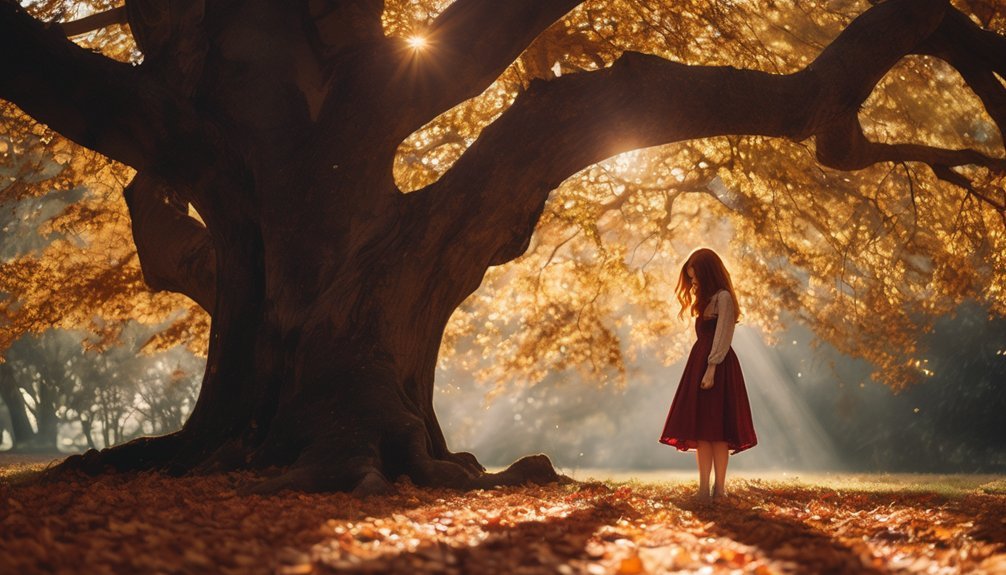
Autumn is the protagonist and first-person narrator of If He Had Been With Me, a teenage girl growing up in a Midwestern town whose story unfolds across four years of high school. She narrates from a post-tragic vantage point, sitting in Finny’s room after his death, reflecting on everything that led to that moment.
Her home life shapes her deeply. She lives next door to her childhood best friend, Finny, their mothers having been close since middle school. Her father’s chronic absences weigh on the family, leaving her mother struggling and Autumn leaning closer to her mom as a result.
She’s not your typical high school girl. She wears a tiara as a signature accessory, resists conformity, and gravitates toward misfits. She dates Jamie, a dark-haired, brooding boyfriend she prioritizes above herself. Her group of misfit friends provides her with a sense of support and acceptance that helps anchor her through the turbulent years of adolescence. By the novel’s end, she is pregnant, carrying both loss and fragile hope forward.
Understanding Autumn as a character is inseparable from understanding her as a symbol. Laura Nowlin did not name her protagonist Autumn by accident. Every aspect of the character (her personality, her relationships, her emotional journey, her pregnancy) maps onto the season’s dual nature: simultaneously beautiful and in the process of ending. For a full character breakdown, see our complete character guide.
Autumn as a Symbol: Seasonal Decline and Emotional Loss
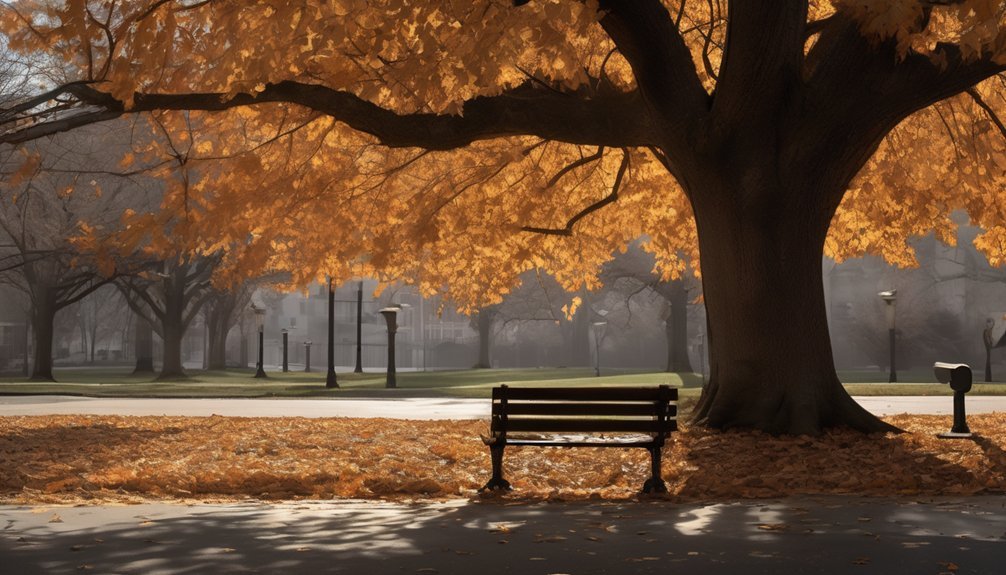
When you look at the seasonal imagery woven throughout If He Had Been With Me, you’ll notice that leaves and roses don’t just decorate the story; they carry its emotional weight. The falling leaves signal transience and inevitable decay, while autumn roses capture beauty at its peak just before it dies, mirroring the novel’s emotional cycles. Together, these images quietly argue that love, like the season itself, blooms most brilliantly right before it fades.
Leaves and Roses
Throughout Laura Nowlin’s If He Had Been With Me, leaves and roses serve as the novel’s most intimate seasonal symbols, embodying decline before it fully arrives. Autumn roses don’t simply die; they deteriorate as they bloom, mirroring Autumn’s emotional unraveling amid outward normalcy. Falling leaves reinforce this, visualizing how relationships shed quietly before anyone acknowledges the loss.
| Symbol | Represents | Character Connection |
|---|---|---|
| Dying roses | Beauty destroyed before potential | Autumn’s emotional deterioration |
| Falling leaves | Inevitable, silent loss | Friendship’s gradual dissolution |
| Withering flora | Internal psychological states | Characters’ hidden pain |
These botanical images aren’t decorative; they’re doing structural work, grounding abstract emotional pain in something you can actually see and feel alongside the characters.
Love’s Fleeting Nature
Beyond botanical imagery, the novel’s most pervasive seasonal symbol is the protagonist’s name itself. “Autumn” foreshadows everything: peak connection collapsing into isolation, warmth cooling into indifference. Love here doesn’t fade gradually; it fractures, mirroring fall’s abrupt temperature drops.
Here’s what the seasonal symbolism reveals about love’s impermanence:
- Initial inseparability shortens like autumn daylight, proving nothing lasts
- The lunch table “War” signals relational frost replacing former warmth
- Unspoken “what ifs” accumulate like fallen leaves, blocking renewal
- The car accident tragedy strikes after graduation, at the moment, everything should have been beginning
- The pregnancy hint suggests new cycles while reinforcing ongoing loss
The novel’s message is uncomfortable but honest: love blooms, wilts, and repeats without guaranteeing that the next bloom will arrive. Laura Nowlin intentionally embraces this discomfort, aiming to depict the messiness of life and relationships while still conveying hope even in darkness.
What Fall Leaves and Roses Tell Us About Autumn’s Place in the Story

What strikes most readers is how the foliage mirrors Autumn’s internal contradictions. She wears a tiara amid fall imagery, her whimsy refusing to surrender to decay. Yet the scattered leaves also echo buried emotions resurfacing at dangerous moments, paralleling the reburied framed photo she can’t quite let go of.
Roses bloom at their most breathtaking right before they begin to die, and that tension sits at the heart of what autumn roses symbolize in this novel. Laura Nowlin uses this imagery to capture Autumn’s fleeting happiness with Finny: beauty that’s already unraveling the moment it peaks.
The roses don’t just decorate the setting; they foreshadow everything:
- They bloom fully, then die immediately, mirroring Finny’s tragic fate
- They reflect Autumn’s momentary joy before inevitable heartbreak
- They parallel the stillborn child metaphor for unfulfilled love
- They connect romantic beauty to its predetermined end
- They reinforce that life offers no guarantees, only fleeting splendor
The leaves even frame how her friends receive her eccentricities, softening her quirks within seasonal warmth. But that warmth doesn’t last. As leaves fall, so does stability, preceding tragedy, uncertainty, and loss. Autumn’s name was never coincidental. She is the season: beautiful, changeable, and inevitably surrendering to something colder.
What Does the Framed Photo Reveal About Autumn and Finny?
While the autumn rose captures beauty at the edge of loss, another symbol works more quietly: a framed photo that sits between Autumn and Finny’s worlds like a witness to everything they never said.
That photo shows them as inseparable children, frozen in a moment before high school pulled them into separate social orbits. It doesn’t change, and that’s exactly the point. While their relationship grows complicated and distant, the image holds its ground in shared family spaces, reminding both of them what they once were.
The photo functions almost like surveillance: Autumn tracks Finny indirectly through it, and he mirrors that awareness. It represents unspoken feelings neither character confronts directly.
After Finny dies, the photo becomes unbearable. It transforms from a nostalgic artifact into proof of a missed chance. The childhood closeness it captured never evolved into what it might have been, and that silence becomes the novel’s deepest wound. Their neighboring adjacent homes made this shared closeness possible, keeping the memory of that bond alive even when words between them had long since faded.
What Autumn’s Tiara Reveals About Her Symbolic Role
Few accessories carry symbolic weight the way Autumn’s tiara does. It’s not just a quirky fashion choice: it’s a declaration of identity. In a high school environment built on conformity, Autumn’s tiara signals her deliberate refusal to fit in, marking her as an outsider with integrity rather than insecurity.
Her friend group reinforces this symbolism. They’re misfits who wholeheartedly embrace her tiara-wearing, turning the accessory into a shared emblem of belonging among the unconventional. The tiara connects to the autumn symbolism in a specific way: just as the season is most vivid and distinctive before it surrenders to winter, Autumn herself is most recognizably herself when she stands apart from everything around her.
The tiara reveals several layers of Autumn’s symbolic role:
- It represents her commitment to following personal expression over social expectations
- It contrasts sharply with mainstream high school norms represented by the cheerleader world Finny inhabits
- It signals a break from the childhood friendship that predated her misfit identity
- It reinforces her belonging within an accepting circle of genuine friends
- It transforms quirkiness into a form of quiet resistance and self-definition
Ultimately, the tiara doesn’t isolate Autumn; it defines her. And like the season she’s named for, it is most vivid and most itself when everything around it has begun to change.
The Stillborn Child Metaphor and Why Autumn’s Name Is the Novel’s Most Layered Symbol
Autumn’s tiara sets her apart visually, but the novel’s stillborn child metaphor reaches much deeper; it makes her love for Finny feel not just unrequited, but fundamentally impossible.
The metaphor compares Autumn’s love to a child conceived but never allowed to live. It didn’t die after flourishing; it never got the chance to breathe at all. That distinction matters enormously. It reframes her feelings as something tragically viable yet structurally doomed.
Their middle school split created the conditions for that death. The war over the lunch table widened their social worlds until crossing back felt unthinkable. When Autumn buries Finny’s framed photo, she’s not moving on; she’s fearing what resurrection might cost her. The act of reburial foreshadows everything: the photo’s drawer depth mirrors the hidden tragedy waiting to surface, unearthing it marks the turning point toward fatal separation, and Autumn’s reburial signals she already senses the danger ahead.
Names carry weight in fiction, but Laura Nowlin’s choice to call her protagonist Autumn does something few character names manage: it turns a person into a living metaphor. Autumn isn’t just a character; she’s a season personified, embodying peak beauty before inevitable decay.
Her name operates on multiple symbolic levels simultaneously:
- Transience: like falling leaves, her happiness never fully settles
- Emotional instability: autumn’s unpredictable weather mirrors her turbulent inner life
- Doomed romance: her love with Finny blooms and dies like late-season roses
- Loss without closure: the season ends abruptly, mirroring life’s messiness
- Hope amid decay: autumn precedes winter but also promises spring’s return
What makes this name remarkable is its layered inevitability. Autumn doesn’t just experience decline; she is decline and renewal simultaneously, making her the novel’s most concentrated symbol. Every image Laura Nowlin attaches to the season she is named for quietly accumulates into a portrait of someone whose story was always going to end this way.
How Every Autumn Symbol Points to Finny’s Death
Every symbol tied to Autumn quietly points toward Finny’s death, building dread long before the crash occurs. The fall leaves, with their peak beauty before decay, and the autumn roses, blooming and wilting in the same breath, frame Finny’s life as something destined to end too soon. Even the buried photo, hidden and then reburied, signals that some connections can’t survive being brought back into the light.
The falling leaves foreshadow loss. Throughout If He Had Been With Me, falling leaves don’t just mark the season; they track Finny’s death like a slow countdown. Every autumn image compounds the dread, making his fate feel written into the landscape itself. Turning and falling mirrors the characters’ drifting apart emotionally. Red leaves link directly to blood and the crash’s violent outcome. Leaf decay signals irreversible loss of childhood innocence. Repeated autumn scenes build tension toward the tragic culmination. Decay patterns reflect how their friendship wilts before fully breaking. Laura Nowlin doesn’t use autumn decoratively; she uses it mechanically, each falling leaf tightening the story’s grip until Finny’s death lands with crushing inevitability.
The roses signal tragic endings. Autumn’s very name roots her identity in a season defined by beautiful, irreversible decline. Roses amplify this connection perfectly. Autumn roses bloom and die simultaneously, making them natural symbols of beauty colliding with inevitable loss. The symbolism cuts deeper than aesthetics. Roses represent the fragility of human connection itself, specifically the bond between Autumn and Finny. Their simultaneous blooming and dying visually echoes what’s happening between these two characters: something beautiful exists while destruction approaches. Autumn’s name, her season, and the roses surrounding her identity all point toward the same tragic destination. Laura Nowlin fundamentally telegraphs Finny’s death through nature’s own imagery long before it happens.
The buried photo predicts Finny’s fate. A buried photograph becomes one of the novel’s most quietly devastating symbols when Finny digs it out and repositions it where Autumn can see it. She reburied it because their renewed closeness felt too dangerous. That act of reburial foreshadows everything: the cycle of unearthing and reburying predicts how their bond resurfaces only to be permanently buried alongside Finny himself.
How All the Symbolism Works Together
What makes the symbolism in If He Had Been With Me so effective is that it does not rely on individual symbols working independently; it operates through a system in which every image reinforces every other, building a cumulative emotional argument that the reader absorbs throughout the novel before the final chapters make it explicit.
Autumn’s name establishes the framework. Everything else maps onto it. The falling leaves, the dying roses, the framed photo, the tiara: each one takes on meaning because the name has already established the season as the novel’s dominant metaphor. Remove the name, and the other symbols lose some of their resonance. Keep the name and every botanical image becomes a reference back to it, creating a web of meaning that tightens with each chapter.
The symbolism also operates on different time scales. Some symbols work in the immediate moment: the roses bloom and die within a scene, the leaves fall and are gone. Others work across the entire novel. The tiara is present from the beginning and persists through the end. The photo is buried and unburied across years of narrative. Autumn’s name is on the first and last pages. Laura Nowlin layers these different time scales deliberately, so that some symbols create immediate emotional impact while others create the sense of inevitability that defines the novel’s structural argument: that what happened was always going to happen.
The symbolism also works in two directions simultaneously. On one level, it signals loss and decline: autumn is the season before winter, the moment before death, the beauty before the ending. On another level, the season also contains the last harvest, the last warmth, and the promise that what falls will eventually become the soil for something new. The pregnancy at the novel’s end activates this second reading. Autumn does not just represent loss. She represents the cycle in which loss becomes the condition for renewal, and that ambivalence is precisely what makes her the right character to carry this story.
How these symbols connect to the novel’s themes. The seasonal symbolism does not exist in isolation from the novel’s larger thematic concerns. It is the aesthetic expression of everything the themes say directly. The themes of unspoken love, missed connection, grief, and survival all have their symbolic correlatives in the autumn imagery. The unspoken love is the stillborn child. The missed connection is the buried-and-reburied photo. The grief is the falling leaves and the dying roses. The survival is the pregnancy: a new life in the midst of everything else ending. For a complete exploration of how these themes develop across the narrative, see our full themes analysis.
Why this symbolism resonates with readers across generations. One of the reasons the BookTok revival of this novel worked so effectively is that its central symbolism, a person named for a season of beautiful endings, is immediately, intuitively understood. You do not need to analyze autumn to feel what it means. You have experienced it. The season carries its emotional meaning in lived experience before you ever open the book. Laura Nowlin’s choice to build her protagonist’s entire symbolic identity on something readers already feel in their bodies rather than something they have to decode is part of what makes the novel’s emotional impact so immediate and so lasting. Analysis reveals the structure of the symbolism. But readers feel it before they understand it, which is the deepest kind of literary achievement.
How Does Autumn’s Relationship With Her Mother Function Symbolically?
Autumn’s mother is one of the novel’s quieter symbolic threads. Her depression and struggles with her father’s absence mirror Autumn’s own emotional fragility. The bond between them (close, mutual, and sometimes fragile) represents one of the few stable emotional anchors in a story defined by things that won’t stay still. When Autumn spirals after Finny’s death, her mother’s presence is part of what structures her eventual survival.
What Do Everyday Objects and Small Gestures Symbolize in the Novel?
Laura Nowlin uses small objects and gestures throughout the novel to carry emotional weight that a direct statement cannot. The shared history between Autumn and Finny is built through a series of small moments: the bus stop, the family dinners, the habits of childhood that persist into adolescence. These everyday experiences serve as symbolic evidence of what the characters mean to each other and what they stand to lose. The novel’s emotional impact depends on this accumulation: by the time tragedy arrives, the reader has been shown hundreds of small details that make the loss feel catastrophic rather than abstract.
How Do Autumn Roses Connect to Themes of Hope Amid Tragedy?
Autumn roses capture how hope and tragedy intertwine; they bloom brilliantly before dying, just like Finny’s relationship with Autumn. They remind you that love’s most intense moments often arrive right before loss, yet beauty still persists. This is consistent with the novel’s broader emotional argument: that grief and love are not opposites but the same feeling experienced at different distances from loss.
What Role Does the Lunch Table War Play in Autumn’s Symbolism?
The lunch table war mirrors Autumn’s inner decay. It represents the moment their separate social worlds stop being awkward and become declared enemies. For the novel’s symbolism, it marks the point at which autumn’s slow drift has become full separation: the warmth of childhood inseparability replaced by the cold of open social conflict. It deepens her symbolism by reflecting that separation, lost innocence, and relationships fading like autumn’s fleeting decline are not gradual; they can accelerate suddenly when circumstances demand it.
What Other Motifs Appear Alongside the Autumn Symbolism?
The rainstorm that kills Finny is one of the novel’s most important motifs beyond the autumn imagery. Rain runs through the novel as a recurring element, and the storm that ends Finny’s life represents the culmination of everything the autumn symbolism has been building toward: beauty and danger arriving simultaneously, without warning, in the same moment. The pregnancy at the novel’s end functions as the counter-symbol: where autumn imagery signals endings, the pregnancy signals continuation. New life growing inside irreversible loss, spring inside autumn, is the novel’s final symbolic statement. For a deeper exploration of how these themes interconnect, see our themes analysis.