In *Steps to Nowhere*, you’ll find that Autumn’s friend group forms through shared rejection rather than common interests. Each member knows what it feels like not to fit in, and that shared wound pulls them together quickly. They’re misfits who recognize each other, building loyalty on mutual understanding instead of social status. Sasha, Finn, and the others don’t just share space; they share survival. Keep going, and you’ll uncover just how deep these bonds really run.
Key Takeaways
- Autumn’s friend group forms through shared experiences of rejection and social exclusion rather than common interests or hobbies.
- Sasha serves as Autumn’s closest friend and emotional anchor, offering stability amid social upheaval and personal turmoil.
- Finn, Autumn’s childhood friend, creates tension within the group as his rising popularity strains their unresolved emotional connection.
- Adam’s unexpected, tragic death adds significant emotional depth, profoundly impacting the group’s dynamics and relationships.
- Autumn’s tiara symbolizes personal identity and independence, with the group’s acceptance of it fostering genuine belonging among members.
Who Are the Main Characters in *If He Had Been With Me*?
You’ll also notice Jamie, Autumn’s boyfriend, who represents her attempt to build a romantic life independent of Finn. He contrasts sharply with the unresolved feelings she carries for her childhood friend.
Then there’s Sasha, Autumn’s closest confidant, who helps her navigate a sense of belonging after earlier social exclusion.
Together, these characters shape a story about missed connections, quiet regret, and the bonds that define you even as you try to move past them. At the center of it all is Adam, whose unexpected, tragic death gives the novel its most devastating emotional weight.
How Shared Rejection Brought Autumn’s Friend Group Together
When you look at how Autumn’s friend group forms, you’ll notice that shared rejection does more of the heavy lifting than shared interests ever could.
Each member carries some version of the same sting the feeling of not quite fitting where they thought they’d belong — and that common wound pulls them toward each other.
You’re fundamentally watching misfits recognize themselves in one another and decide, almost instinctively, that this is where they stay. This dynamic plays out against the broader backdrop of peer pressure and social dynamics that define the high school experience in the novel.
Exclusion Forged Real Bonds
Though popularity shapes so much of high school social life in *If He Had Been With Me*, Autumn’s friend group doesn’t form around status it forms around the absence of it. Exclusion redirects emotional energy away from fitting in and toward people who actually understand you.
| Bond Element | What It Replaces | Why It Lasts |
|---|---|---|
| Mutual recognition | Mainstream approval | Rooted in honesty |
| Shared disappointment | Social climbing | Builds real trust |
| Intimate communication | Broad acceptance | Deepens over time |
| Loyalty within the group | Peer validation | Tied to survival |
| Common outsider identity | Status-based belonging | Feels earned, not given |
When you’re pushed out of dominant circles, the people who welcome you carry more weight. That’s exactly what shapes Autumn’s closest friendships.
Misfits Finding Each Other
Autumn’s friend group doesn’t start with shared interests or deliberate choice; it starts with shared rejection. When you’re pushed to the edges of the social hierarchy, you begin noticing others who occupy the same margins. That recognition happens fast. You don’t need a formal introduction—outsider status does the work before conversation even begins.
But conversation is what seals it. Once these characters actually talk, abstract alienation becomes a concrete connection. They’re not misfits by a single defining trait; they’re misfits because they fit poorly into every conventional label the school offers. That shared misalignment becomes their common ground.
You’ll notice the group doesn’t form from the center of school life, it builds from the edges outward. Rejection redirects these characters toward each other, turning exclusion into the foundation of something real. Their loyalty to one another deepens precisely because shared social rejection creates a sense of understanding that no insider group could replicate.
Who Is Sasha and Why Does She Matter to Autumn?
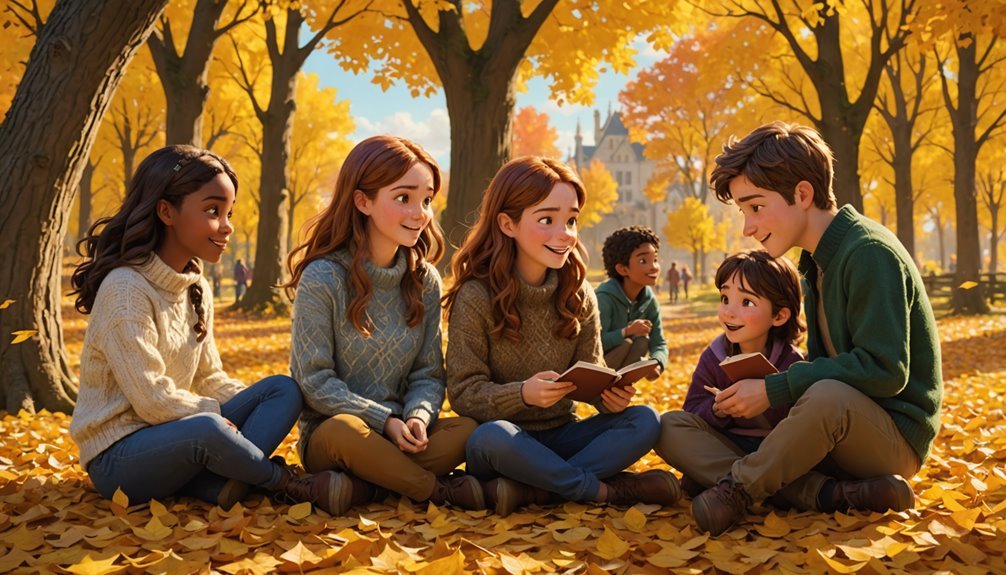
If you’ve been following Autumn’s social journey, you already know that her shift away from the popular crowd didn’t happen alone — Sasha is the best friend who made that change possible.
The two have been close for three years, bonding over a shared experience of exclusion that pushed them both toward an alternative, outsider-leaning circle.
That connection gives Sasha a unique role in Autumn’s life, serving as an emotional anchor during one of the most unstable periods of Autumn’s high school years. When a mean girl tried to drive a wedge between them, Sasha demonstrated her loyalty by rejecting the invitation outright.
Sasha’s Origins With Autumn
Before high school reshapes everything, Sasha stands as Autumn’s closest friend, a bond rooted in their shared middle school years.
You can trace their connection back to a time when both girls were part of the same social circle, before that group fractured and left them on the outside.
That shared exclusion from the cheerleading-centered crowd becomes the foundation of something stronger.
When the middle school friendships collapse, Sasha and Autumn don’t drift apart they build something new together.
You see how that pivotal period cements their closeness rather than weakening it.
Their history matters because it shapes who Autumn becomes.
The friendship isn’t accidental it’s a direct response to early social instability, giving Autumn a peer she can rely on as everything around her shifts. Sasha’s priorities, however, remain heavily focused on relationships and boys, a dynamic that foreshadows the tension that eventually drives the two apart.
Shared Exclusion Builds Bonds
What cements Sasha’s importance isn’t just the history she shares with Autumn it’s what that history produces. When you look at how their friendship forms, you see two people bonding not over acceptance but over rejection.
They both step away from the popular crowd at the start of high school, and that shared exclusion becomes the foundation of everything between them.
Their outsider circle doesn’t form despite marginalization; it forms because of it. That distinction matters. You’re watching a group that turns displacement into identity, where belonging depends on being left out of the mainstream.
Sasha isn’t incidental to that dynamic. She’s central to it. Without her, Autumn’s break from conventional high-school status loses its most visible anchor and its clearest emotional reinforcement.
Sasha As Emotional Anchor
Sasha doesn’t start as a complication in Autumn’s life; she starts as a lifeline. After Autumn loses her footing in an earlier friend group, Sasha provides continuity when everything else feels uncertain.
She’s not a background character; she’s an active partner in rebuilding Autumn’s social identity from scratch.
What makes Sasha valuable isn’t just her presence but her timing. She appears when Autumn most needs a trusted peer, offering stability during the messy transition to high school.
Their shared focus on boys and relationships creates an immediate bond, one that mirrors Autumn’s priorities rather than challenging them.
Sasha represents one of Autumn’s few genuinely reliable connections until romance destabilizes everything. When Jamie falls for Sasha, that lifeline snaps, turning Autumn’s closest support into a source of real tension.
Why Autumn’s Friends Were Pushed Out of Mainstream High School Culture
High school social hierarchies can be brutal, and Autumn’s friend group felt that pressure firsthand. When you move through a school system that rewards visibility, conformity, and the right social connections, smaller circles get pushed to the margins almost automatically.
Autumn’s friends didn’t fit the gatekeeping system that popularity runs on. That system demands the correct image, the right network, and behavior that mirrors the dominant crowd. If you’re not reflecting that back, you’re easy to overlook.
Popularity runs on gatekeeping and if you’re not reflecting the right image back, you’re easy to overlook.
Friendships also shifted as Autumn moved toward a more popular crowd after middle school. That change widened the gap between her tighter circle and the mainstream. You can see how social reinvention works against long-standing bonds when newer affiliations redefine group membership entirely.
What kept her friends together wasn’t status, it was loyalty and shared outsider identity.
But in a culture that prizes group visibility, those qualities don’t protect you from being sidelined.
Who Is Finny, and How Did His Distance Change the Group?
Finny isn’t just a background character in Autumn’s story he’s the absence that quietly shapes everything. He’s Autumn’s childhood best friend, practically family, until high school reshapes them both into strangers occupying opposite social tiers.
| Finny Then | Finny Now |
|---|---|
| Childhood best friend | Most popular guy in school |
| Next-door neighbor | Dates super-popular Sylvie |
| Constant presence | Awkward, distant figure |
| Part of Autumn’s world | Belongs to the elite crowd |
That shift doesn’t just hurt Autumn emotionally; it restructures her entire social identity. When Finny moves toward the popular crowd, Autumn gets pushed toward the outsiders. Her friend group forms in the space he vacates.
What makes this dynamic cut deeper is that your families still interact, so the distance never fully resolves. You carry the tension of someone who’s simultaneously close and completely unreachable across all four years of high school.
How Romance and Rivalry Strain Autumn’s Close Friendships
When Finny drifts toward the popular crowd, he doesn’t just leave a gap in Autumn’s life he sets off a chain reaction that strains every close friendship she’s left. You can see how his growing circle of soccer friends and her search for acceptance push them onto separate social paths, reducing everyday contact and weakening the group’s cohesion.
Romance makes everything worse. Unspoken attraction creates tension before anyone confesses a thing, and dating outside the original circle pulls loyalty in new directions. You watch the group splinter as emotional energy shifts toward newer bonds rather than older ones.
Silence fuels the damage. Major feelings stay buried, misunderstandings multiply, and regret over not speaking sooner becomes a constant undercurrent.
When senior year forces everyone back together, those hidden emotions are harder to contain.
What Autumn’s Tiara Reveals About Who She Really Is
Autumn’s tiara isn’t a fashion statement, it’s a declaration. When her parents first allowed her to make self-directed dress choices freshman year, Autumn didn’t blend in. She crowned herself. That decision tells you everything about who she is: someone who’d rather follow a personal whim than meet anyone else’s expectations.
The tiara signals independence, quirkiness, and a commitment to self-expression that doesn’t bend under social pressure. It’s visual shorthand for a character who builds identity through small, visible acts of difference. She’s not performing royalty she’s performing herself.
What makes the symbol richer is how her friend group responds. They don’t mock the tiara; they embrace it. That acceptance turns the accessory into part of a shared dynamic, a marker of genuine belonging.
Later social distance in the larger narrative makes that early acceptance feel even more significant. The tiara reveals a character balancing bold individuality with a quiet need to be truly seen.
Conclusion
You’ve now seen how Autumn’s friend group in *If He Had Been With Me* isn’t just background noise they’re the emotional heartbeat of her story. Each character shapes who she becomes, challenges her assumptions, and mirrors her deepest fears. They’re bound together by rejection, loyalty, and complicated love. Understanding them means understanding Autumn herself, and that’s what makes Laura Nowlin’s novel hit so much harder than you’d expect.
Frequently Asked Questions
Does Autumn’s Friend Group Appear in Any Sequel or Companion Novel?
You’ll find Autumn’s friend group in *If Only I Had Told Her*, the companion novel. It keeps the same central cast, continuing their story through grief, healing, and the emotional aftermath of Finn’s death.
How Many Total Members Make up Autumn’s Core Misfit Friend Group?
You’ll find that Autumn’s core misfit friend group has four total members. They’re Swann, Nora, Autumn, and Kat, four teenage girls who form an unbreakable bond during the summer of 1995 in *Lost Records: Bloom & Rage*.
Did Any of Autumn’s Friends Have Rivalries Outside the Main Storyline?
You won’t find clear evidence that Autumn’s friends had rivalries outside the main storyline. The available sources don’t confirm any side-character conflicts, focusing instead on Autumn, Sam, and the story’s central dynamics.
Are There Real-Life Inspirations Behind Autumn’s Alternative Friend Group?
You won’t find any confirmed real-life inspirations behind Autumn’s alternative friend group. The group likely draws from common autumn friendship traditions, such as pumpkin picking, haunted houses, and Friendsgiving, rather than any identifiable real-world clique or person.
How Does the Friend Group’s Dynamic Change After the Novel Ends?
You won’t find confirmed details about how the friend group’s dynamic changes after the novel ends. Available sources don’t verify any specific outcomes, so it’s best to treat the aftermath as currently unclear.